
Learn more about eye conditions, eye diseases and more!
Featured articles
[metaslider id=”1042″]
Explore more
Latest Eye A-Z articles
- The Complete Guide to Overnight Contact Lenses That Stop Myopia from Getting WorseClear daytime vision without glasses. Discover how Ortho-K helps manage myopia in kids. What are Orthokeratology, or ortho-k, Hard Contact Lenses? Ortho-K lenses are specially designed contact lenses worn overnight to gently reshape the cornea. By morning, your child can enjoy clear, natural vision all day without the need for glasses or contact lenses. OrthoK is an innovative, non-surgical solution particularly effective for managing myopia (nearsightedness) in children. The ortho-k lenses are worn at night to reshape the front surface of the eye while you sleep. Vision improvements are reversible but can be maintained if you keep wearing the lenses as directed. Why Choose Ortho-K Lenses for Myopia Management? The lenses work by flattening the centre of the cornea, changing how light is bent as it enters the eye. Most Ortho-K lenses are worn overnight to flatten the cornea, then removed during the day. These overnight lenses are rigid, gas-permeable lenses that are sturdy enough to reshape the cornea, but also allow oxygen through so your eye stays healthy. When ortho-k lenses are removed, the cornea stays flattened for a while and vision is corrected without the need for glasses. If you stop wearing the lenses at night, your eyes will eventually go back to their original shape, and the refractive error will return. You have to keep wearing the lenses regularly to maintain the vision correction. How Do Ortho-K Lenses Work? Nighttime Wear: Ortho-K lenses are worn while your child sleeps. The lenses gently and painlessly reshape the front surface of the eye (cornea) overnight. Daytime Freedom: Upon waking, the lenses are removed, providing clear vision throughout the day without the need for glasses or daytime contacts. Ongoing Management: Regular (daily) use of Ortho-K lenses has been shown to slow down the progression of myopia, helping to reduce the risks associated with high myopia later in life. Who Can Benefit from Ortho-K Lenses? Children and teenagers with myopia (nearsightedness). Those who are active in sports and outdoor activities. Kids who find glasses or regular contact lenses uncomfortable or inconvenient. Anyone looking for a non-surgical way to manage myopia. How Efficient is Ortho-K Treatment? Research indicates that children who wear Ortho-K lenses show a 30-50% reduction in myopia progression compared to those who wear regular eyeglasses or contact lenses. This reduction is achieved by temporarily reshaping the cornea overnight, resulting in clear vision during the day and minimising the eye’s tendency to grow longer, which is a primary cause of worsening myopia. What to expect during an Ortho-K examination? Orthok lenses are not typical contact lenses that you can buy from a shop, and whether it is good has nothing to do with the brand. Every pair of orthok lenses needs to be expertly fitted for treatment to take effect. We will map and measure the surface of your cornea using an instrument called a corneal topographer and then design a lens especially for your eye. The cornea map is created by reflecting light off the surface of the eye. The machine doesn’t touch your eye, and there is no pain. The corneal topography map shows the shape and curves of your cornea. Things to take note of Please bring your glasses during your appointment. It can take two weeks or longer to attain the maximum vision correction from Ortho-K. Avoid any soft contact lens wear 1-2 weeks before your ortho-k appointment. Terms and Conditions Offer applies to immediate family members Optometry Centre Locations Singapore: Tampines, Bukit Batok, Upper Serangoon Johor Bahru: MidValley SouthKey Kuala Lumpur/Selangor: MidValley MegaMall, Taman Melawati, Taman Setiawangsa, SS2 Jalan Petaling Jaya Melaka: Lebuh Ayer Keroh Negri Sembilan: Garden Homes Seremban Penang: Georgetown Eye Clinic Locations Johor Bahru: Menara Pelangi
- Comprehensive Eye Exam: Why is it important, and what to expect?Why is it important to have a comprehensive eye exam regularly? Keeping an eye on your vision requires different care and attention at different stages of life. Even when we are young, we should do a comprehensive eye check-up regularly, as eye problems can be present at any age. Did you know some eye diseases, such as glaucoma, have no symptoms? Having a regular eye check-up gives you the best chance of diagnosing any underlying eye diseases. Your eye doctor can also help to evaluate your eyes as an indicator of your general well-being. What is the difference between a vision screening and an eye exam? Vision screenings are basic eye tests to help recognise any issues with your vision, but it does not test for any underlying eye diseases. Usually, it checks for basic refractive errors such as myopia, astigmatism, and hyperopia. A comprehensive eye exam performed by an optometrist or ophthalmologist involves a thorough examination of all aspects of your vision. Your eye doctor will be able to diagnose visual health issues and ocular conditions that are otherwise unable to be determined by vision screening. What to expect from a comprehensive eye exam? History Taking Your eye care professional will ask for your background and health history, as existing medical conditions may increase the potential risk of developing certain eye diseases. Visual Acuity Test This is a test to measure how well you can see in different distances by asking you whether you can see numbers and letters of varying sizes using an eye chart. Refraction This is a test to measure your type and degree of refractive error to determine your exact eyeglasses prescription. Eye Pressure Test Usually done with a tonometer, this test measures your eye pressure that checks for glaucoma: an eye condition that can cause vision loss due to built-up eye pressure damaging the eye’s optic nerve. Check the front of your eyes: Slit Lamp Test The front part of your eyes will be examined under high magnification to detect any abnormalities such as cataracts and macular degeneration. Check the back of your eyes: Retinal Imaging / Fundus Examination A high resolution, wide-angle picture of your retina will be captured to detect any abnormalities such as retinal detachment in the back part of your eyes. Assessment and Management After the eye exam, your eye care professional will advise you on the test results and steps needed if abnormalities are detected. A comprehensive eye exam may involve more tests depending on your ocular conditions but these are the most common and will help cover a wide spectrum of eye diseases. How often should you go for a comprehensive eye check-up? Babies (Age 6 months onwards) Ensure that your child’s eyes are screened during regular pediatric appointments and they are free from common childhood eye conditions and diseases. Children and Teenagers (Age 3 to 19) Ensure that your child has a thorough eye check every 1-2 years during routine health check-ups or when getting fitted for corrective eyewear, such as for myopia. Young Adults (Age 20 to 39) Have a comprehensive eye examination if you have a family history of eye disease or if you are suffering from an eye injury. Adults and Seniors (Age 40 onwards) Eye conditions such as age-related macular degeneration are more likely to occur as we grow older. To monitor vision changes, you should get a baseline eye disease screening when you are 40 and ask the doctor to assess how often you need to return for follow-up screenings. For Anyone with Risk Factors If you have a risk factor for eye disease (Diabetes, high blood pressure, family history of eye disease), you should see your eye doctor annually. Ask your eye doctor for the ideal interval between check-ups. Have not had a comprehensive eye exam in the past year? Regular eye checks help detect issues early and keep your vision at its best. Take a moment to care for your eyes today. Book your appointment today. Sources: https://www.healthhub.sg/a-z/diseases-and-conditions/776/eye-examinations-for-eye-diseases https://www.essilor.com.sg/vision/eye-exams-tests https://www.allaboutvision.com/eye-exam/expect.htm https://www.webmd.com/eye-health/eye-doctors-optometrists-ophthalmologists https://woptics.sg/comprehensive-eye-examination/ https://www.healthprofessionals.gov.sg/docs/librariesprovider6/default-document-library/english-ver–moh-oob-code-of-professional-conduct-(oct2018).pdf
- Astigmatism: Causes, Symptoms, and Treatment
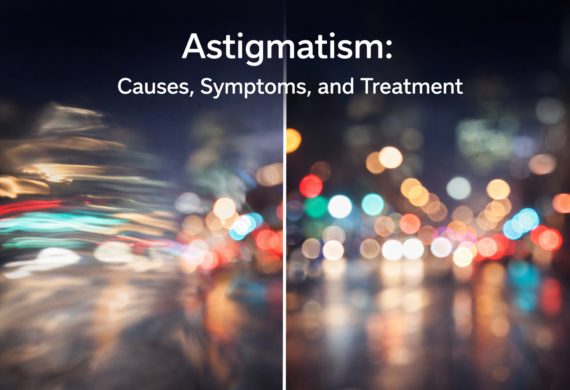 What is Astigmatism? Astigmatism is a common vision condition caused by an irregular shape of the cornea or lens. Instead of having a perfectly round curvature, the eye is shaped more like a football, causing light to focus unevenly on the retina. This results in blurred or distorted vision at all distances. Astigmatism occurs when the cornea or lens has an uneven curve. Because of this irregular shape, light entering the eye does not focus evenly on a single point on the retina, leading to blurry or distorted vision both near and far. Astigmatism Causes and Risk Factors Astigmatism is often present at birth and may be inherited. It can also develop after an eye injury, surgery, or due to certain eye conditions. Common causes and risk factors include: Certain eye diseases Genetic factors Irregular corneal shape Eye trauma or surgery Astigmatism Symptoms Symptoms of astigmatism may vary depending on severity but commonly include blurred or distorted vision, eye strain, headaches, difficulty seeing at night, and frequent squinting to improve focus. Childhood Astigmatism Astigmatism can occur in children and may affect visual development if left uncorrected. Children with astigmatism may have trouble reading, focusing in school, or recognizing distant objects. Early detection through regular eye exams is essential to support healthy vision development. Astigmatism Treatment Astigmatism can usually be corrected with prescription eyeglasses or contact lenses designed to compensate for the irregular curvature of the eye. In some cases, refractive surgery such as LASIK may be an option for adults, depending on eye health and prescription stability. An eye care professional can recommend the most appropriate treatment based on individual needs. Sources: https://www.mayoclinic.org/diseases-conditions/astigmatism https://my.clevelandclinic.org/health/diseases/8576-astigmatism https://www.nei.nih.gov/learn-about-eye-health/eye-conditions-and-diseases/astigmatism https://www.webmd.com/eye-health/astigmatism
 - Farsightedness (Hyperopia): Causes, Symptoms, and Treatment
 That means that you should still be following any shelter-in-place orders in your community. But when you’re venturing out to the grocery store, pharmacy or hospital, it’s wise to wear one…
 - Nearsighted vision (Myopia): Causes, Symptoms, and treatment
 That means that you should still be following any shelter-in-place orders in your community. But when you’re venturing out to the grocery store, pharmacy or hospital, it’s wise to wear one…